
Certified translation
What we certify, the exact wording of our certificate, and how a translation is set out, sealed and recorded.
What we certify
A certified translation from Global Lingua is a complete translation of the document we were given, certified in writing by the company as true, complete and accurate. The certificate is signed by Ahmed Hassan, Managing Director and Authorised Signatory.
The certification covers the translation. It does not certify that the original document is authentic: that is established by the authority that issued it and through legalisation.
The certification statement
Certificates issued from 17 October 2026 state, word for word (the details of each document are shown here in square brackets):
I, Ahmed Hassan, Managing Director and Authorised Signatory of Global Lingua for Certified Translation, hereby certify that, to the best of my knowledge and belief, the translated document in English attached hereunto is a true, complete and accurate translation of the original document in Arabic likewise attached. The translation was prepared by a qualified translator of the company, who is competent to translate from Arabic into English. This certified translation comprises [n] pages issued by the company, followed by a copy of the original document ([n] pages), making [n] pages in all. Each page bears the company seal.
أقرّ أنا، أحمد حسن، المدير العام والمفوَّض بالتوقيع عن شركة جلوبال لينجوا للترجمة المعتمدة، بأن الترجمة الإنجليزية المرفقة ترجمةٌ كاملة وصحيحة ومطابقة للمستند الأصلي المحرَّر باللغة العربية المرفقة صورته ([نوع المستند] رقم [رقمه] الصادر عن [جهة إصداره] بتاريخ [تاريخ إصداره])، وذلك على حدّ علمي واعتقادي، وقد تولّى ترجمته أحد مترجمي الشركة المؤهَّلين للترجمة من اللغة العربية إلى اللغة الإنجليزية. ويتكوّن هذا الملف من [عدد] صفحات صادرة عن الشركة تليها صورة الأصل في [عدد] صفحات، وعلى كل صفحة منه خاتم الشركة. حُرِّر في مدينة الشيخ زايد، الجيزة، في [تاريخ التوقيع].
- For a translation into Spanish the statement is in Spanish, with a note that it is a certification issued by the company and not a sworn translation under Spanish Royal Decree 724/2020.
- Where an authority requires the translator's own certification (United States, Australia, New Zealand, UK settlement), the certificate names the translator and adds the translator's signed declaration of competence; for Canada it adds an affidavit to be sworn before a notary. The wording required in Ireland is used only when the original was seen.
- Certificates issued before 17 October 2026 state that the translation is true and accurate, and their QR code holds the certificate data instead of a link. They are checked on the verification page with the certificate number and the verification ID.
Format of the certificate
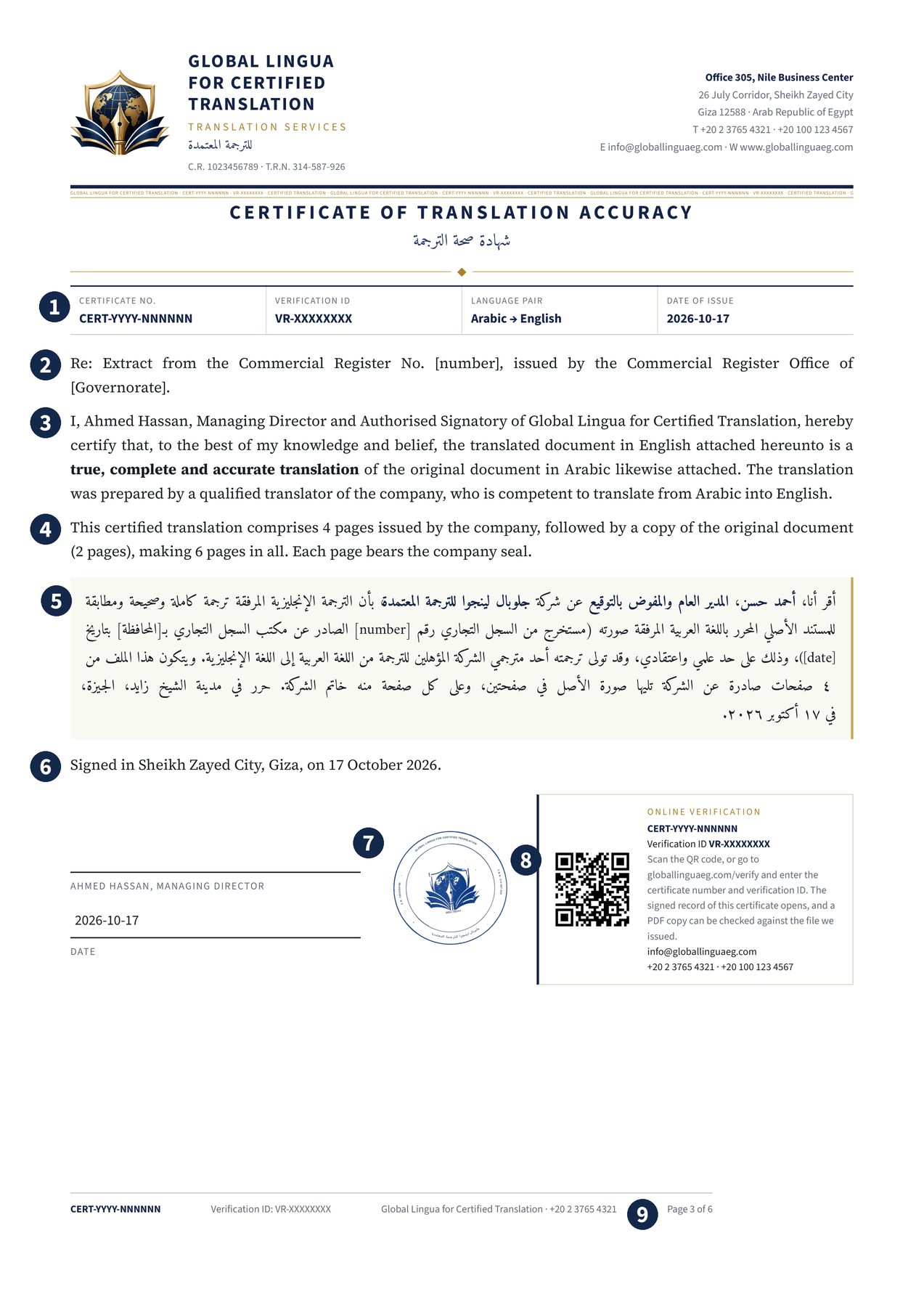
- Certificate number and its revision, verification ID, language pair and date of issue
- The original document: type, number and issuing office
- The certification statement in the language of the translation
- The pages of the translation and of the original
- The same statement in Arabic
- Place and date of signature; the signatory's name and position
- The company seal
- The QR code, certificate number and verification ID that open the signed record
- “Page (x) of (y)” at the foot of the page; the total counts the pages of the original
Set out like the original
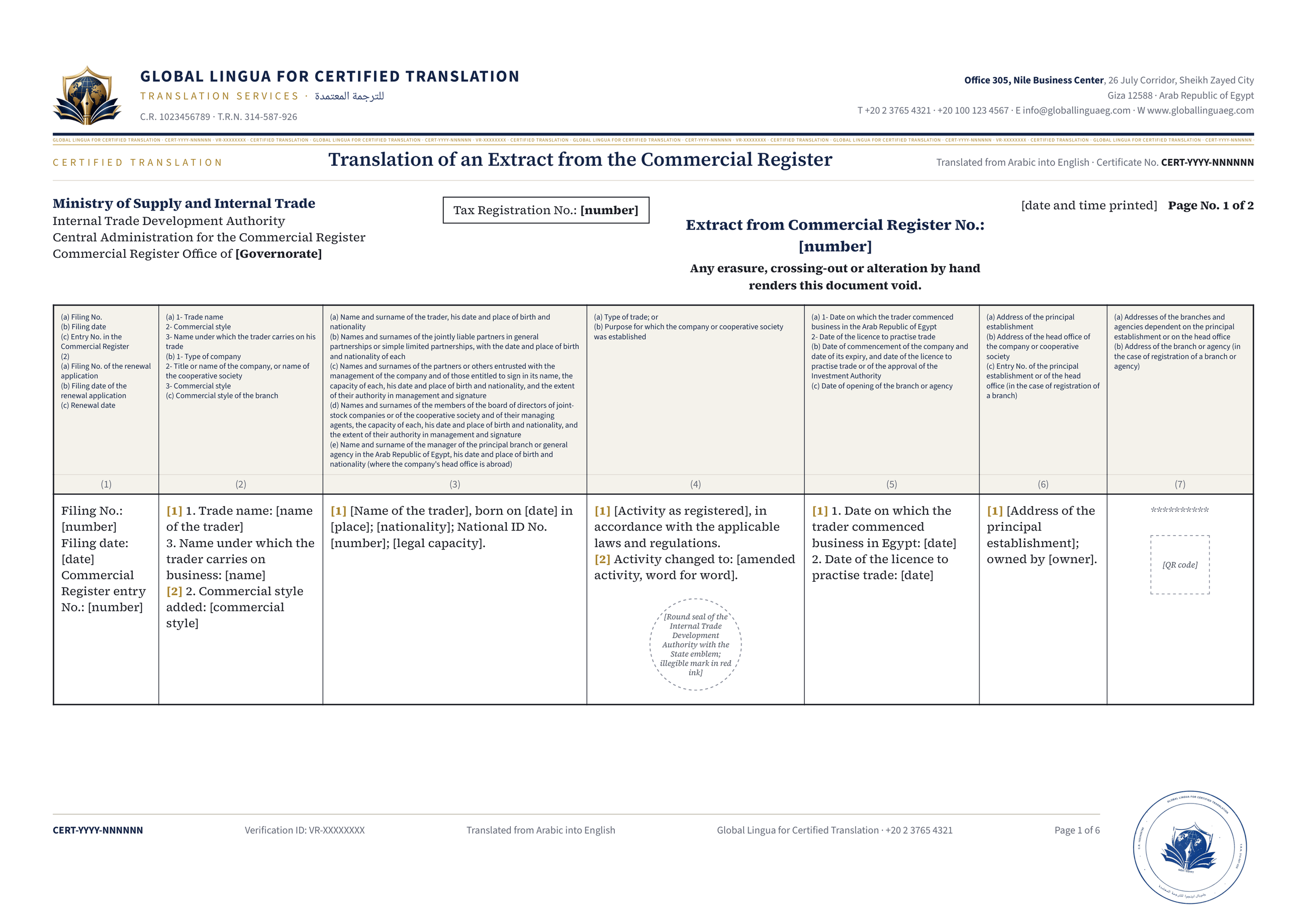
The AUSIT Style Guide (version 2.0, 2026) asks that, where possible, a translation have the same number of pages as the original, with the same content on each page, so that the two can be compared side by side. The 2024 guide of the UK translators' associations ATC, CIOL and ITI asks that the formatting be consistent with the original as far as possible. A commercial register extract keeps its fourteen numbered columns and the column widths of the printed form; an identity card keeps its front and back.
For an Arabic original the page is mirrored in the translation, so that it reads from left to right; the column numbers stay as printed in the original.
Seals, photographs and other non-text elements
They are not copied into the translation as images. Each is described in square brackets where it stands on the original.
| In the translation | What it stands for |
|---|---|
| [Round seal: …] | A seal or stamp, with the words it bears |
| [Photograph of the holder] | A photograph |
| [Signature] | A handwritten signature |
| [Illegible handwritten mark in red ink] | Handwriting that cannot be read |
| [QR code] | A QR code or barcode |
| [State emblem] | The emblem of the State |
| [Security hologram] | A hologram or other security feature |
The original, the seal and page numbers
- A copy of the original follows the translation, the certificate and the annex cover in the same PDF.
- Every page of the translation, the certificate and the annex cover bears the company seal, the certificate number, the verification ID and “Page (x) of (y)”.
- Every page of the copy of the original bears the company seal, the certificate number and its page number.
The signed online record
When a certificate is issued, its record is signed with the company's private key (ECDSA P-256 with SHA-256) and published on this site, normally within seconds. The record holds the SHA-256 fingerprint of the issued PDF. The verification page checks the signature in the reader's browser and compares a PDF copy with that fingerprint without uploading it.
Verify a certificate · Information for receiving authorities
Limits of a company certification
- It is not a sworn translation or a translation by a court-appointed translator; countries that require a sworn translator do not accept it in place of one.
- It is not a notarisation. Where an authority requires a notarised affidavit, as Canada does, the translator signs it before a notary.
- It is not a legalisation. Egyptian documents are legalised by the Ministry of Foreign Affairs and then by the destination's embassy.
Names and numbers
- Personal names are spelt as in the holder's passport when we receive it, and the same way throughout.
- Company names are transliterated, not translated.
- Registration and identity numbers keep every digit, without separators; amounts stay in the original currency.
- An error printed in the original is translated as printed.